Ana Baranda
AmeriCorps Project POWER- Team 15
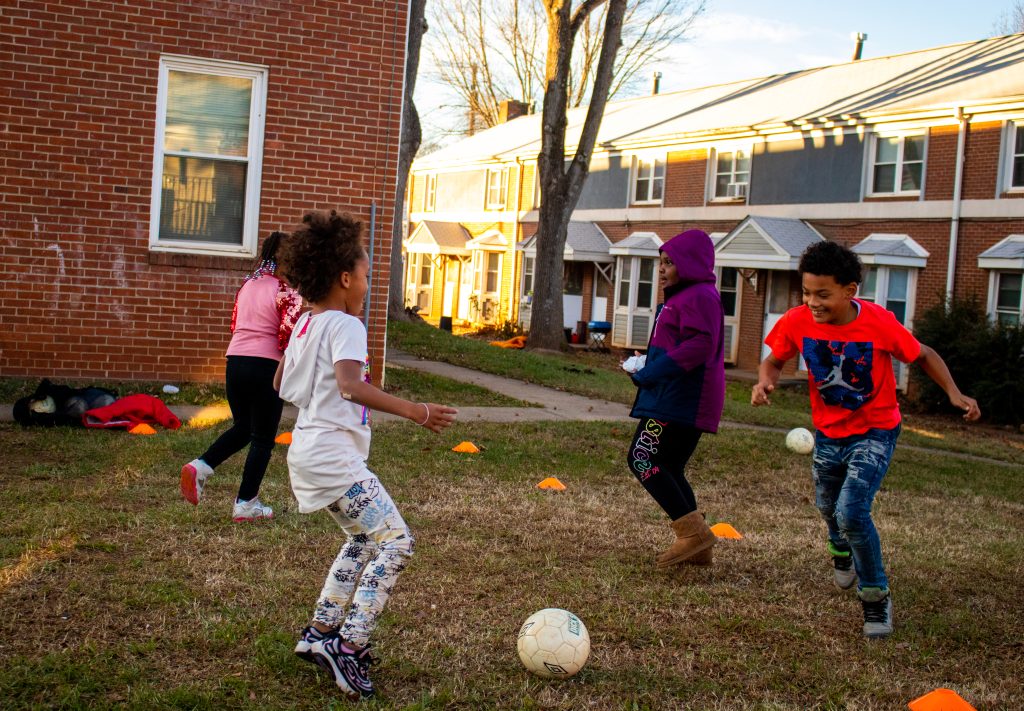
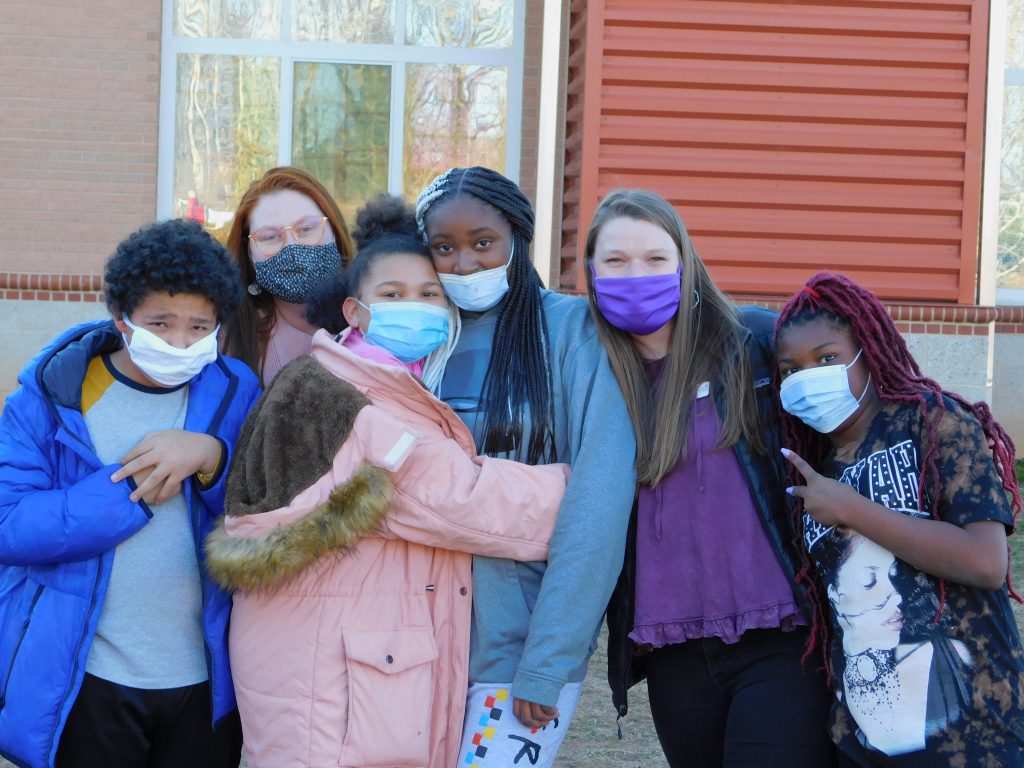
Every afternoon in the office has been accompanied by a lunch break that lets me step outside the monochrome office and sit in what is a stranded sliver of available play space at the warehouse. The Newcomer Migrant program is housed in this space, and it welcomes youth whose families have just made Buncombe County their new home. The boys take up a game of soccer after lunch and will kick a ball over a roof every once in a while. I met a group of girls who prefer to sit on the sides and watch the game go on. One of them, whose name escapes me, is the quietest and seemingly shiest one of all.
She tends to cover her smile in a recognizable and pedantic fashion. It is not unusual for her to do this at every chance encounter we have. Maybe a reason why these girls stand out to me comes from the observation of a specific ritual that we engage in during our residency here- one that happens in their classroom and inside my office.
The site where I have been placed at reminds me of a battleground, not one that shines of visible animosity, nor of boisterous challenges, but of internal struggle. What the girls and I share is the routine of sitting and hearing others tell us what to do. While the requests I’ve received have usually fallen on the needs of my project, they have been tinged with reflections on social inequality, office protocol and community alliances. I know that they are listening to requests of what they should be inside and outside of the classroom. Their days are immersed with English language mastery drills and American culture lessons. It seems as if we are exploring our roles in this community, and negotiating what kind of purpose we have in these new environments that contest our identities.
I can’t stop thinking of that non-existent, non-smile, because it reminds me of the smile I carried when I was a child. I have recently found the courage to unravel that smile, and share it with a knowing sense of audacity, after a scathing acculturation process that moved me like a tiny bead on an abacus. I enjoy these afternoon breaks because they allow me to remind myself why I remained committed to this project, and to look for positive points in its challenges. Maybe one day while I’m here, she will decide that it’s okay to share her smile too.
Jordan Diamond
Project POWER/AmeriCorps
The sun was so bright when I walked outside, that I turned on my heel and high-tailed in back inside to grab my sunglasses, hoping the throng of children on the playground hadn’t spied “The Garden Teacher” just yet. Upon my return, they were seated beneath the shade of three evergreen trees.
“Today in the garden we are going to…” I began, pausing for effect, but not expecting much response. “Make cornhusk dolls!”
But alas, I was greeted by cheers. My ears could hardly believe the volume of said cheers. Why, in the past three weeks I’d led a garden club with the Asheville Community Design Lab (ACDL) after school kids, only 3 or 4 had wanted to come. But today, ten boys and girls marched beside me. I noticed the glow of the sun brighten by a few degrees, and I could feel creativity buzzing behind me.
In the garden, seated at a picnic tree beneath the gentle vines of Mother Willow Tree, Magnus and Aubrey handed out cornhusks to the other children. I explained how to tie the yarn around the husk to make a head, arms, and legs.
“Can I go figure this out for myself, then teach others?” A voice from the end of the table piped up. The source was Zada, a little girl who had just made a crown of vines and placed it upon her head.
“Well sure! What a great idea!” I replied, looking up from the doll I was modeling with.
Zada walked off to sit on the “magic lion” statue while I helped the little ones tie their string. I moved on from child to child, showing them how to fold arms out of the husks and helping them tie double knots. I noticed, after several minutes, that the table was rather empty, and that the older girls in the group had migrated to the lion statue by Zada.
“You should check it out- they made a full-on doll factory over there.” The ACDL counselor, Courtney, said to me.
Sure enough, the four girls had created an assembly line for making cornhusk dolls. Two younger girls were the “sales girls” in the “doll store”, selling the dolls being made in the back of the “factory”. And these dolls were no ordinary dolls! They had capes made of leaves, scarves made of braided yarn, turbans and snow hats, hula hoops made of dead vines from the willow tree, hair, faces, clothing, and more! It really was rather astounding, and more and more of the children came over to join in their game. The Doll Factory suddenly needed a larger building and shelter from the wind. The children relocated to a teepee not far off, and quickly got to work, using the branches as shelves for their materials.
“We all have an important job, Garden Teacher! I sell dolls, she makes scarves, she makes hats, and she makes hair!” Sienna, a kindergartner, exclaimed with a huge grin on her face as she pointed to each child.
I was blown away by their ingenuity. For the past week, I had done this craft with two other groups of children, but these girls took my simple craft idea to the next level and beyond. The power of creativity in young children is amazing, and there’s no telling the directions they can go when given mediums to let their imaginations fly through.
Sarah Kellogg
Project POWER/AmeriCorps- 2012
I am an environmentalist, meaning I love exploring and learning about nature, and I actively seek to protect it against the whims of our consumer driven society. As an environmentalist, I see the world differently than many around me and every day this leads to a sinking feeling deep in my soul that the move to sustainability I believe our world must make will not, and possibly cannot, happen fast enough. Every time I watch an individual make a simple choice, such as to use plastic bags at the grocery store or to drive a mile rather than walk, I see their choice as a result of a much larger, systemic issue that plagues society and thus humanity. The pervasive issue is an unwillingness to change, especially for the sake of “the environment”, and a perpetual denial that change must occur at all. Even as an environmentalist, I am not immune to this mentality. Daily, I make choices that are not sustainable and I rationalize my decisions with the notion that we still have time. But, if I have learned anything, it is that we must use less now because we are on this planet together, and it is all we have.
Transitioning my mind from an overwhelming sense of catastrophic despair to my daily work with children is actually a pleasant and generally easy task. I enjoy working with children because they are so open to new ideas and are usually eager to grow and change, rather than resistant to it. Maybe it’s because they haven’t spent enough time in society to be fully brainwashed by its litany of capitalist-consumer rhetoric, but at times, kids seem to see the world more clearly than adults. Their sense of exploration leads them to an easy, natural understanding that the world is an awesome place, something worth admiring and protecting. With some encouragement, all kids will find their way to the dirt and the trees, and there they can establish a relationship with nature that will endure their lifetimes. However, some children take more encouragement than others, in fact, our society has become so anthropocentrically contrived that some kids may make it through their entire childhoods without ever being exposed to nature. In my mind, this is a tragic loss, for their sakes and for humanity’s.
With this as my background, imagine my excitement when the YMCA accepted my proposal to work as an environmental education specialist for all five of the Western NC summer camps! Finally, I was presented with a chance to teach young minds about the concept of limited resources and to lead eager, young bodies into the woods where they could learn to love even the ugliest bugs. Over the course of the summer, I taught over 300 kids the importance and limits of food, water, and shelter. I taught them why it is more important to reduce and reuse than to recycle. I taught them to see high, low, and far from the trail and how to identify plant and animal species with field guides. I encouraged almost every child not just to touch a snake, but to see the snake as a creature with personality and emotions. Every day, I encountered small successes that put hope in my heart and a smile on my face. But the greatest success of all was also the smallest. One day, about half way through the summer, I was leading a small group around Bell Elementary on the hunt for spiders, interesting plants, birds, wildflowers, and poison ivy. Although we were successfully exploring, I felt overwhelmed by the behavior (or lack thereof) of my group and I was worried that they weren’t getting as much out of the activity as I had planned. In an effort to dispel the numerous arguments and loud tendencies of my group, I led the kids into a poison-ivy free patch of woods and began explaining how to indentify sassafras. As the kids were pointing out this and that interesting thing and fighting over the sassafras leaf I had picked for them to smell, one little girl got my attention and said, “Ms. Sarah, I never knew nature was fun”. I could have cried. Even if none of the kids in my group, or even in the whole summer camp, came out of my lessons with the ability to differentiate between poison ivy and sassafras, the fact that I had shown one child that nature was something “fun”, something she could love, meant that I had done my job. Even though my actions were far from momentous, the fact that I had simply given her access to nature meant that I had connected her to it. Without me, she might have gone through her whole life viewing nature as some abstract concept of trees and whales “out there somewhere”, rather than realizing that nature is something the human heart is instinctively drawn to and that it is all around us, ready for exploring.
James Sisk
Project POWER/AmeriCorps
Hyenas and Trolls: A Search for the Self
Troll: A supernatural being in Norse mythology and Scandinavian folklore. In Old Norse sources, beings described as trolls dwell in isolated rocks, mountains, or caves, live together in small family units, and are rarely helpful to human beings.
Hyena: Carnivorous harlequin, phylogenetically similar to felines and viverrids, yet behaviorally and morphologically similar to canines.
Deep into the blue-ridge jungle, past the blooming rhododendron groves and paths forgotten, we found evidence that suggests the existence of supernatural beings; deep bite marks on broken tree trunks, and strange footprints leading nowhere.
Entangled like veins underneath the earth’s skin, root systems crawled every which way, providing foot holds up the mountain and rolled ankles for the distracted. As the sounds of the distant highway faded we were reminded of ourselves. However, rare moments of epiphany are usually short lived when the audience consists of day campers; hell-hounds enjoying the dog days of summer, living wild with no school work in their book-bags.
Beneath the bird’s nests and towards the wilderness city kids argued and bickered like a pack of domesticated hyenas, loitering on the sacred grounds of their ancestors. Troubled with the burdens of popular culture and competitive social arrangements, these combative souls marched through the thickets and around mud puddles deep as the ocean, growing weary of our seemingly endless voyage into the vast unknown.
Our assignment was to go on a nature hike.
A hike, or what is considered by some to be an annoying reason to knot one’s shoe strings, was a rare activity for these city youth. The prospect of walking long distances in the woods received criticism frequently throughout the early stages of our expedition. Yet, as the human is able to break loose from the tangled web of our society, we are able to focus our thoughts on more imaginative topics. And so, as the trip progressed so did the groups attitude towards the hike, the bickering ceased, and the hyenas turned into adventurers.
After a while time had passed, we had traveled far from the safety of our packed lunches and four-square courts. As the trees grew towards the sun, and spots of light trickled through the leaves onto the forest floor, we began to take notice of our isolation from civilization; we no longer knew which direction the highway was, and hadn’t yet begun to realize that we had entered the homestead of creatures not often seen by human eyes and minds.
As the trail narrowed our minds expanded. No longer surrounded by popular culture and the domineering pressures of society, we walked through the wilderness. I mentioned the existence of fairies and goblins to the group, and I talked about a troll that I had once seen. I explained to the group the basic characteristics of trolls, including their general habitats and normative behaviors towards humans- excluding of course the harsh realities of the ‘Jutnar’ that reside in the ancient realm of ‘Muspelheim’. But of course I was just trying to instigate imagination, I couldn’t truly believe in Trolls.
The group consisted of fourth graders, old enough to be critical of the supernatural, but young enough to keep an eye out, if only to catch a glimpse of a fairy, goblin, or of course a troll, before their peers did.
As we continued, the hike became a safari, the lime green moss was fairy bedding, and each odd shadowy shape was a goblin, if only for a brief moment. We walked up, down, and over the mountain’s side, finding sticks that had been used by Trolls as tooth picks, and deer-paths that had also been heavily trafficked goblin sidewalks.
The ability of the human mind to become imaginative had redefined the purpose of our assignment.
And as the adventurous hyenas explored rocks and hollow tree trunks for the supernatural, their minds were too distracted by the possibility of life to think about all the competitive pressures of society that made their lives tough. But I knew of course, that this was only a small window of opportunity to escape the aforementioned tangled web, that trolls weren’t really out there, and what these kids were searching for was themselves.
As the sun set even more West across the sky, and the woods became darker, we walked back towards the highway. As the sounds of distant cars returned we crossed familiar pathways, and comfortable root systems, telling stories of what we had seen on our safari.
Just as the group was about to leave the wilderness we were confronted with the discovery of a strange footprint on the ground. The footprint was large in diameter, and unrecognizable in form, compared to that of a human. Exhibiting an abnormally large set of toes and claws, much larger than that of the bear around this region, we were unable to identify the print.
For the kids this was just another aspect of the imagination; ambiguous clues, that in the mind of a youth, can constitute nothing but fact. To them this evidence suggested the existence of supernatural beings and played a part in the adventure they had just gone on.
However, I still think about that footprint today, and how we were unable to identify the creature that made it. The thought of trolls does cross my mind when I think about that footprint, as if reverting to an earlier form of myself- one in which the imagination is still strong, even at times over-powering.
As I walk through the woods I keep an eye out, observing the oddly shaped shadows, and studying the ground for another footprint like the one we found. I enter the wilderness in search of the supernatural- or at the very least, clues, suggesting the existence of other worlds with infinite possibilities. I have learned to follow the strange footprints leading nowhere, because far from society we can view ourselves as we exist. As I search for fairies, goblins, and trolls, I hope to catch a glimpse of the rarest of all creatures- myself.
*All names of minors changed for the sake of privacy.